Someone recently asked us what’s the difference between an engineer and a surveyor. And you know what? We didn’t know!
In true Explore Careers fashion, we decided to find the answer, and we learned a lot along the way that we think many of you will want to know too.
So, what is the difference between engineering and surveying?
Engineers and surveyors work together
While they are two different roles with different focuses, they do go hand in hand in many respects.
Here’s a brief overview of what each role does:
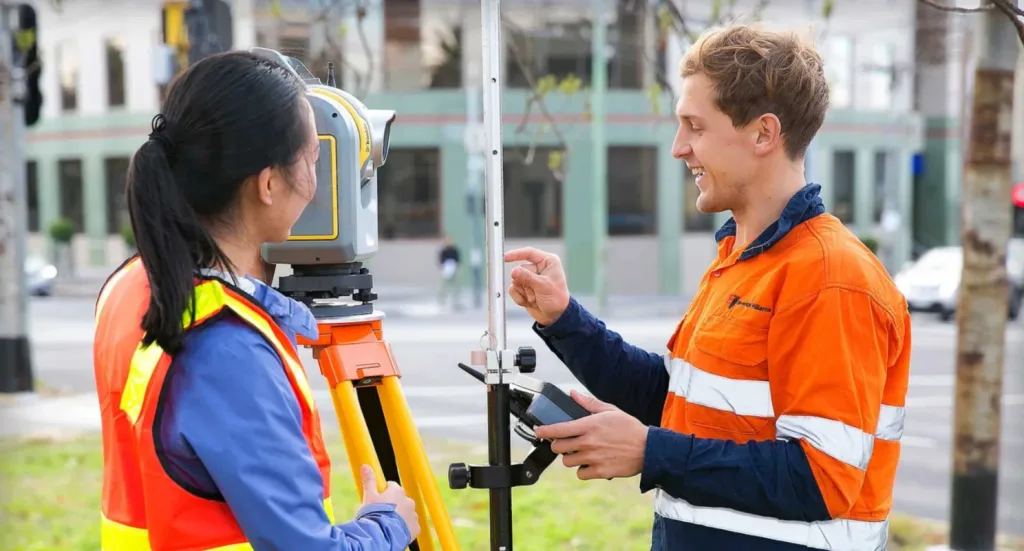
- Surveyors: Surveyors conduct surveys of plots of land to establish measurements, lines and points that building, construction, and engineering projects will refer back to in their designs and developments. Surveyors are usually the first professionals on a site, gathering all the data that other professionals will require to do their work effectively and accurately.
- Engineers: There are many different types of engineers, so for this article and to focus within construction, we’ll focus on civil engineers. Civil engineers also get involved with projects at the very early stages, envisaging, designing, supervising and maintaining a wide range of projects. They tend to focus on urban developments, from office buildings to housing, bridges to dams, airports to shopping centres.
Another way to think about this is to see surveyors as the data people and civil engineers as the design people.
There’s a lot of overlap between the two roles. Some surveyors go on to become fully qualified as civil engineers to deliver in both roles, but they are separate professions, too, with different entry pathways and qualification requirements.
How to become a surveyor
There are two pathways to becoming a surveyor in Australia:
1. Study a surveying degree
If you choose the degree pathway, you’ll need to check the entry requirements by the university and work to achieve the ATAR required to get into your chosen course.
Throughout your degree, it’s essential to take on work experience and internships and show commitment to group projects to boost your technical and work-based skills as much as possible.
Each state in Australia has a different requirement for the practical training hours you should complete alongside industry-specific exams set by your state’s surveyor board.
Once you’ve ticked all the boxes, you can register to become a licensed surveyor and get stuck into your chosen career!
2. Become a survey assistant through a traineeship or apprenticeship
In some states, it’s possible to become a surveyor’s assistant and enter the field without formal qualifications, but you can improve your chances of landing a role by completing a relevant qualification, for example:
- Certificate III in Surveying and Spatial Information Services
- Certificate IV in Surveying
Both are offered through TAFE.
You can also complete a Level 4 Traineeship in surveying, which takes 36 months to complete. This can progress into a relevant apprenticeship, but this will depend on what your local providers and employers have available, so it’s worth checking in with your school careers adviser and local apprenticeship providers.
How to become a civil engineer
To qualify as a civil engineer, you’ll need to complete a four-year bachelor’s degree in civil engineering as a minimum.
These degree programs include a substantial amount of work-based placements that you’ll need to complete to meet the qualification requirements (for many universities, this is a minimum of 100 hours completed on an approved placement, but some may require more hours).
To work as a civil engineer post-study, you’ll need to register for a Professional Engineer’s Licence based on the requirements of the state you live in. These requirements usually include your degree qualification and practical experience, and some may require an entrance exam.
The skills you need
Now you know a bit more about the two different roles, what skills suit each pathway, and where do they overlap?
Let’s take a look:
Engineering skills
- Interpersonal
- Critical reasoning
- Creativity
- Innovation
- Enthusiasm
- Personal motivation
Skills both need
- Problem solving
- Analytical skills
- Decision-making
- Up-to-date technical knowledge
- Communication
- Leadership
- Teamwork
- Presentation skills
Surveying skills
- Interpretative skills
- Data collection
- Precision
- Numerical
- Fact finding
- Commitment
Find out more
If you’re keen to learn more about these career pathways and the other types of roles you could explore, check out our Engineering & Architecture and Construction & Trades industry pages.